Russian Revolution
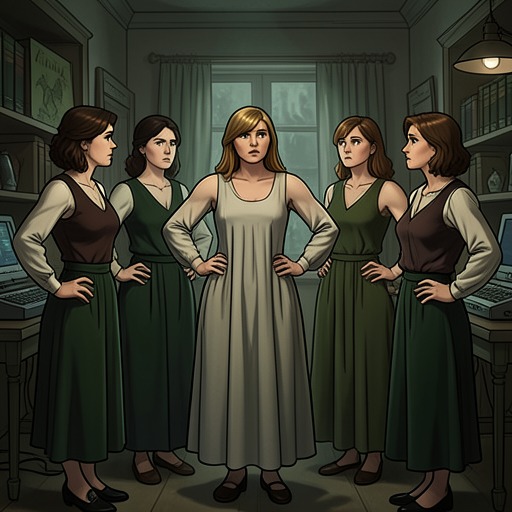
Women TalkingThe Russian Revolution is not retold as a sequence of historical events in the account; it appears as a culturally charged point of reference shaping what the women of the Molotschna Colony believe revolution means. During their debate over how to respond to the crisis, Greta Loewen rejects the label of revolutionaries by associating revolution with soldiers and weapons. The contrast helps define the women’s action as a collective effort to decide their future, not an armed uprising.
A loaded historical reference
Within the Molotschna Colony, any reference to revolution calls the Russian Revolution to mind, which the community regards as having been bad for Mennonites. The account supplies no further history of the Revolution or description of its events. Its significance here lies in the association itself: the name carries a warning, and gives the women’s discussion a historical frame they cannot simply set aside.
That association surfaces when August Epp raises the possibility that the women’s cause might be revolutionary. Agata Friesen objects that the women are not revolutionaries but ordinary women, mothers, and grandmothers. Greta Loewen sharpens the distinction by describing revolutionaries as soldiers, often armed with rifles or bombs, and placing the women on the opposite side of that image. The exchange shows the term’s force in the colony: it is not a neutral synonym for change, but a label linked to armed conflict and a troubling past.
The women’s choices
The debate concerns an immediate choice, not a plan to take power by force. The women have been given three ballot options: do nothing, stay and fight, or leave. Their decision-making takes place under pressure: the men involved in the assaults may return while awaiting trial, and the women have been told that refusing to forgive them could mean leaving the colony. Against that background, the Revolution supplies a feared comparison for the women’s possible resistance, even as the choices before them remain specific to their safety and future.
Ona Friesen asks whether they are willing to die for their cause. Neitje Friesen and Autje Loewen shake their heads. Their response does not erase the seriousness of the decision; it marks a limit on what they are prepared to undertake. The women ultimately agree to leave after dark, planning to pass the Chortiza Colony and Hiakjeke Colony unseen. The plan described is a departure with attention to timing and route, not an armed confrontation.
Revolution and the meaning of resistance
The Revolution’s narrative role is chiefly contrastive. By associating revolution with soldiers and weapons, Greta Loewen identifies a form of political action the women do not claim for themselves. Their deliberation nevertheless challenges the authority governing their choices: they debate the available options together and settle on leaving. The text thus distinguishes the feared image of armed revolution from their collective decision to protect themselves by departing.
That distinction is not presented as a guarantee that leaving will be easy or safe. The women face an outside world they know little about, and their decision follows the threat that they may have to leave if they do not forgive the men. In this context, the Revolution’s shadow helps clarify what the women are—and are not—choosing: they refuse both passive acceptance and the identity of armed insurgents, and make departure their response.
A reference preserved in the minutes
The debate reaches the reader through a record made by August Epp, whom Ona Friesen asks to document the women’s meetings because they cannot read or write. He must translate their spoken Plautdietsch into English as he records it. The minutes are therefore a mediated account of their discussion, not a direct written record produced by the speakers themselves.
Ona also proposes that the pros and cons be written on large sheets of brown packaging paper and kept in the hayloft as artifacts for others to discover, although the women cannot read what is written there. Later, as the group prepares to leave, August gathers his notebooks and the minutes and asks that they be given to Ona; Salome Friesen points out that she cannot read them. These details make the record’s purpose and limits part of the narrative: the women’s deliberation is preserved through another person’s writing, while the historical reference to the Russian Revolution remains one element in the spoken debate the record carries forward.